SPACE-COTS / TECHNICAL ARTICLES
Executive Summary
Lodestar announced completion of a total ionizing dose (TID) test campaign for its GPU-accelerated flight avionics in a release posted on 20 November 2026. The work is relevant to the use of commercial computing technology for spacecraft autonomy. Completion of a campaign, however, is not equivalent to a demonstrated radiation qualification for every mission.
Background: autonomous processing in orbit
Onboard AI can reduce dependence on ground communications by processing sensor data locally. Its implementation requires more than computational throughput: power consumption, heat dissipation, memory integrity and recovery from faults all influence operational availability. Commercial computing architectures can be attractive where system-level engineering compensates for limitations of individual devices.
What the company announced
Lodestar describes its avionics as the computing platform for Mithril Autonomy. The campaign involved Coros Space at Spain’s Centro Nacional de Aceleradores, with support from NVIDIA. The architecture combines edge AI hardware with protective hardware and software measures. These are company-reported details; this article does not assign a numerical dose rating or pass criterion without reviewing the underlying evidence.
Technical interpretation: board-level radiation evidence
A board-level TID campaign can reveal functional degradation arising from interactions between processors, memory, regulators and interfaces. It is particularly useful when the intended application is exercised during exposure. However, a functional check alone may conceal declining timing margins, increased leakage or thermal changes. Total dose testing also does not demonstrate immunity to single-event upsets, latch-up or displacement damage. Separate evidence is required where those mechanisms are relevant.
Space-COTS Assessment: evidence required before design adoption
For an accelerated computing board, define representative inference workloads and establish baseline throughput, execution latency, power consumption, memory errors, reset frequency and output correctness. Track these quantities at documented dose steps, operating temperatures and bias conditions. Capture both aggregate performance and device-level diagnostic information where accessible. Record sample identities, hardware revisions, software versions and annealing conditions. Assign SCCPM evidence statuses: Measured, Not measured, Not reported, Not applicable or Not determined. A recovery mechanism should be evaluated for the time needed to resume a valid operational state, not simply whether a restart occurs.
Conclusion and next steps
The announced campaign is an encouraging example of system-level evaluation of advanced onboard computing. A mission-specific assessment should request detailed test results, establish operational margins and evaluate complementary radiation mechanisms and fault recovery before assigning suitability.
References, provenance and dates
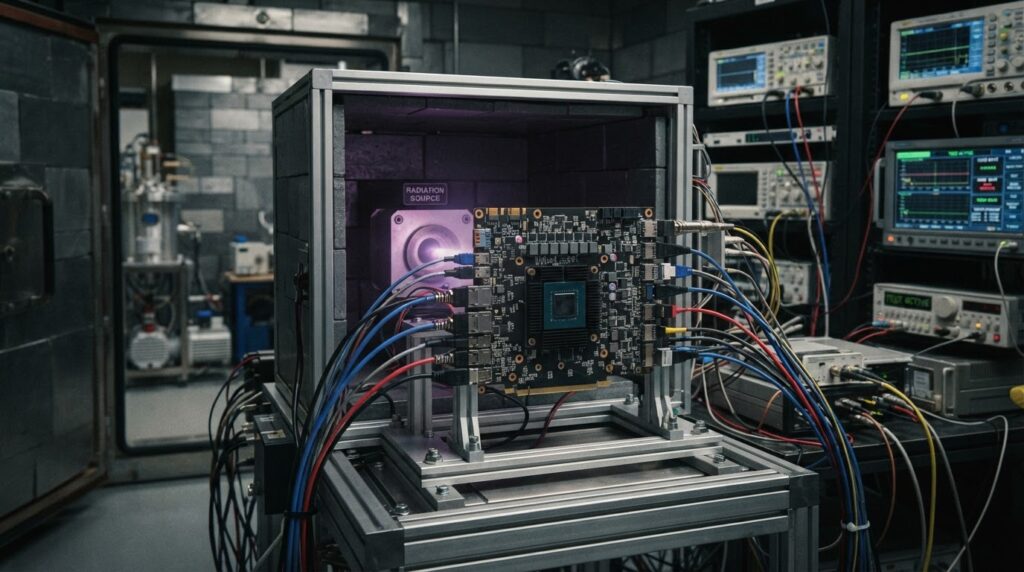
Primary source: Lodestar press release, posted 20 November 2026 (dateline 19 November). Editorial research: 25 November 2026. This is independent editorial analysis, not a Space-COTS test report. Featured image: AI-generated conceptual illustration, not a photograph of the actual test facility or hardware.