SPACE-COTS / TECHNICAL ARTICLES
Executive Summary
On 18 November 2026, EPC Space announced an expansion of its radiation-tolerant gallium nitride (GaN) HEMT portfolio, covering plastic QFN and hermetic packaging. The announcement is relevant to spacecraft power conversion because the package is part of the electrical, thermal and reliability design, not merely an enclosure.
Background: power density and packaging
Higher switching frequencies can reduce the size of magnetic components, but the resulting converter must still meet efficiency, electromagnetic compatibility and thermal requirements. GaN devices offer attractive switching characteristics; the actual benefit depends on gate-drive design, parasitic inductance and operating conditions.
What the manufacturer announced
The expanded range spans 100–200 V devices. EPC Space reports maximum continuous drain-current ratings reaching 133 A and on-resistance values as low as 1 mΩ across the portfolio. These are portfolio extrema, not necessarily simultaneous specifications for one component. Plastic and hermetic options allow designers to consider different assembly and assurance requirements.
Technical interpretation: package-level trade-offs
A plastic package can offer a compact footprint and a short thermal path, while a hermetic package may support different environmental assurance requirements. Neither package designation alone establishes radiation performance or mission suitability. Evaluate junction-to-board thermal resistance, solder joint fatigue, moisture sensitivity, assembly profile and vacuum material compatibility. A converter operating in vacuum must reject heat through its conductive and radiative thermal paths; terrestrial convection assumptions are inappropriate.
Space-COTS Assessment: evidence required before design adoption
Request device-specific TID and SEE reports, including bias, temperature, fluence, particle species, LET and the operating voltage used during irradiation. Destructive single-event behavior deserves particular attention in power switching applications. Characterize on-resistance, threshold voltage, leakage and dynamic switching behavior at relevant operating points. Record measured values and uncertainty before and after irradiation and annealing where appropriate. In the SCCPM, distinguish mission-critical parameters, diagnostic parameters and complementary parameters; assign each an explicit evidence status. Do not transfer results between package variants or production lots without a justified equivalence assessment.
Conclusion and next steps
The broader package offering is a useful development for power subsystem trade studies. Compare candidate devices against the actual bus-voltage envelope, transient conditions, thermal design and radiation environment. Obtain the applicable qualification and procurement documentation before selection.
References, provenance and dates
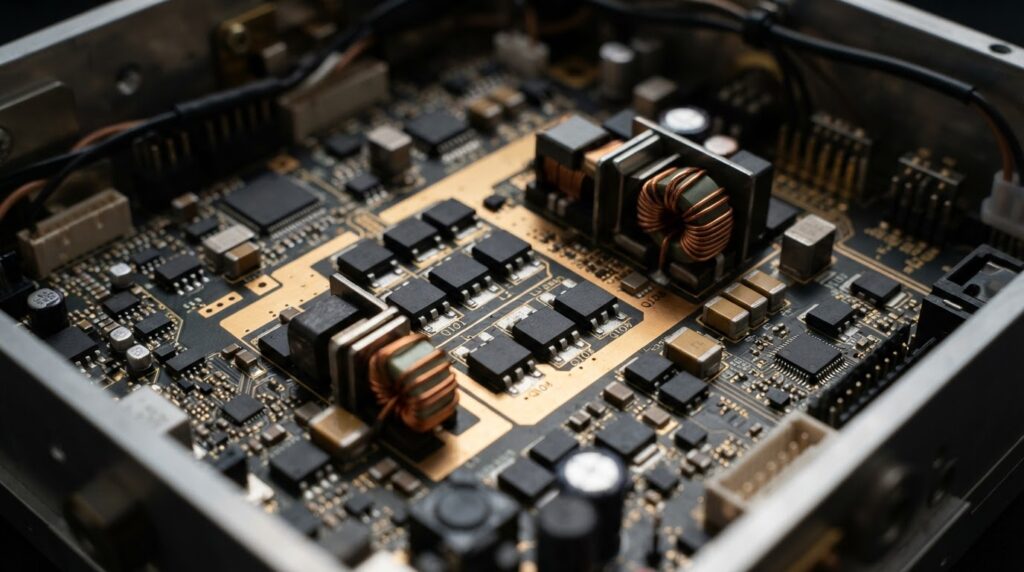
Primary source: EPC Space announcement, 18 November 2026. Editorial research: 25 November 2026. Manufacturer claims have not been independently verified through laboratory testing by Space-COTS. Featured image: AI-generated conceptual illustration, not a photograph of the announced products.