Space-COTS COTS qualified for space applications

Abstract:
COTS components will be used in small satellites mostly without qualification (upscreening).
Qualification tests are very complex and expensive. Space-COTS are COTS components qualified for space applications and following international standards. Due to a new industrial test concept Space-COTS match small satellite mission requirements efficiently and offer the best Price/Quality ratio for space hardware manufacturing.
INTRODUCTION
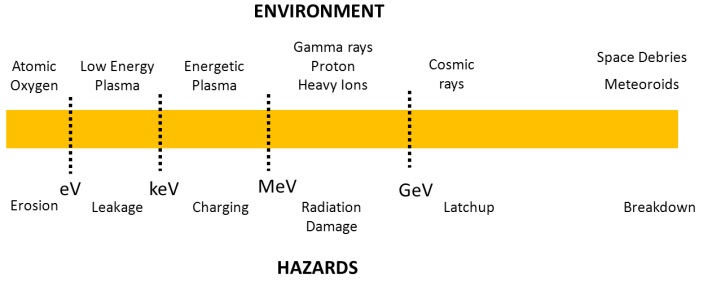
The space environment is surrounded by different physical phenomena. Depending on the physical nature phenomenon, electronics space systems will be affected in one way or another. For a space mission is of necessity to know this environment very well in order to avoid damages and malfunctions in the onboard electronics. The exact behaviour of such physical phenomena in a specific space mission
depends on the satellite’s orbit and it can be simulated with software tools. The simulation results help the satellite developers to design the system accordingly.
In the space environment following kind of physical phenomena can be found:
Atomic Oxygen
UV light break the O2 molecules in single Oxygen atoms. The atomic Oxygen is very reactive and erodes the surface of the satellite structure. This rust affects the thermal behaviour of the structure and of the satellite. This is a very important issue because the spacecraft thermal
control will be impacted.
Plasma
The ionized gases generate electrostatic charges and load the surface of the satellite electrically. The discharge of such loads can affect the operations of the satellite and of the instruments.
Radiation environment
a variety of effects belong to this phenomena. Gamma rays degrade the electronic components. Protons and heavy ions can literally destroy the electronics of the satellite or in the best case corrupt digital data.
Micrometeoroids and space debris
the most dangerous events in the space environment represents small artificial or natural bodies. The impact of micrometeoroid or space debris can damage or destroy the satellite. Such situations have already happened and the consequence was the loss of the spacecraft.
At the beginning of the space era, no space electronics were available at all. Military electronic parts were up-screened for its use in space. In this up-screening process, complementary tests were achieved and the best of them were selected.
In 1973, the Skylab hardware was manufactured using military components. After the qualification test, the hardware has to be improved several times due to encountered malfunctions during the qualification process. These improvements implicated further investments over 3 million dollars for achieving system redundancy; new electronic components and further qualification campaigns were needed.
The electronic systems of the first space shuttle mission (1981) were based also on military elements. In order to increase the reliability of the system most of them were built six fold. Using an elective scheme, the valid data was verified.
The inclusion of redundant systems meant also the increase of weight, power consumption and more hardware and software challenges.
Due to the fact that military electronics were not good enough for space applications and that the up-screening does not always improve the parts, in the 60’s the systematic development of space electronics was initiated. The manufacture of space electronics demands a high quality
production process. In the USA military components were selected and thereafter qualified running additional tests. This strategy allowed the reduction of production costs. Since the space components demand was and is small, the price of these is still high.
Nowadays the qualification of only one component following ESA or NASA Standards implies an investment beginning from 1 million dollar and a certification time of around two years.
The gained experience of the last sixty years in many space missions and with different technologies allowed institutions like ESA and NASA to develop qualification guidelines and standards, which are manuals to be followed and used for the qualification of electronic parts for space missions. The standards defined by the ESA can be found in the European Space Components Information Exchange System (ESCIES) website (https://escies.org/webdocument/showArticle?id=167).
A database of qualified electronic components including their test reports is also available on the ESCIES Website: https://escies.org/labreport/radiationList.
The validation and qualification process consists in the preparation of the hardware and the devices (Device Under Test or DUT) to be tested, the execution of the test itself and the evaluation of the results, which will be published in a test report.
Depending on the mission, few components will be screened during the test or it will be necessary to analize the entire component batch in order to achieve the qualification of the whole system. It means, in some cases few parts are enough to guarantee the qualification of the system (e.g. radiation tests) and in other cases the complete batch (outgassing) has to be tested. During the tests the relevant parameters of the devices will be characterized under space conditions. One important point for a successful qualification is to guarantee that the tested components were produced with a similar manufacturing process; in other words all the qualified parts are identical (geometry, size, materials, etc.), and consequently they belong to the same batch.
After the qualification a test report and a datasheet will be generated containing the parameter values and limits relevant for the use of the electronic parts in space.
A full qualification of a component is very laborious. It takes few years and requests a high financial investment. A full qualification is called “Screening Test”. In the screening test following tests have to be performed:
- Electrical test
- Seal test
- Visual inspection
- Mechanical shocks
- Vibration test
- Constant acceleration
- Thermal test
- Radiation test
- High Temperature Stabilization Bake
- Temperature cycling
- Thermal Shock
- Solderability
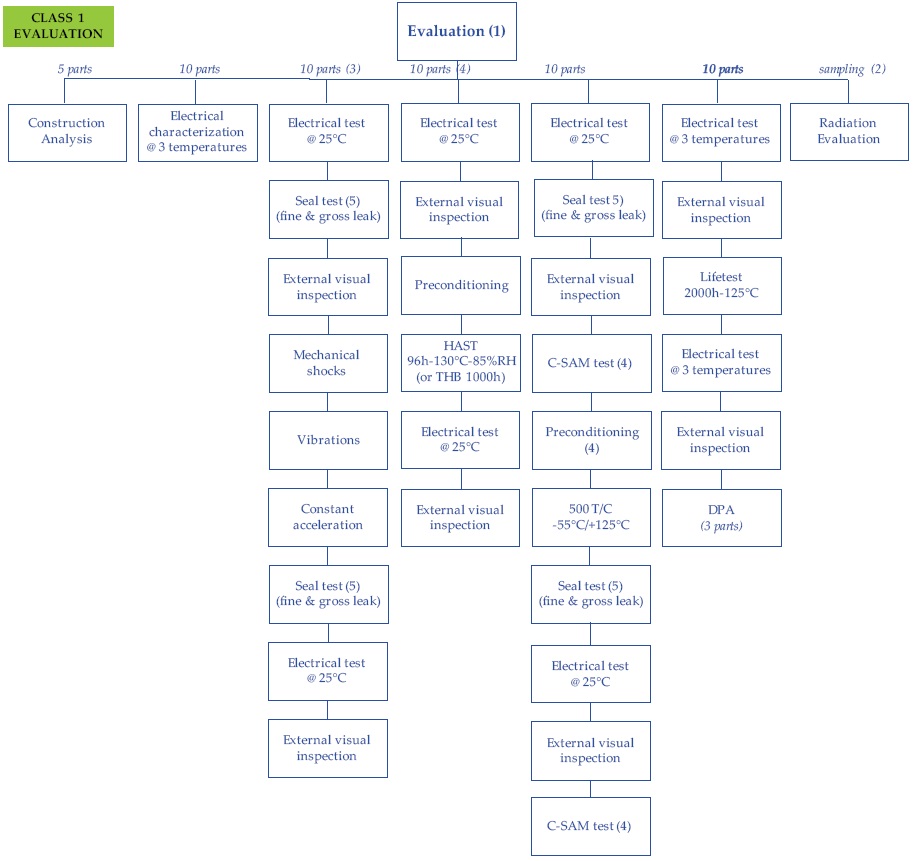
Following the ESA Standards described in the document “ECSS-Q-ST-60-13C_Space product assurance”, tree different classes have been defined [2]. The difference between the classes depends of the deepness of the qualification process. In summary the Class 1 represents a full qualification and the Class 3 a light qualification, mainly radiation testing.
To become an idea how a qualification test is a short description of the Total Ionizing Dose (TID) test follows below:
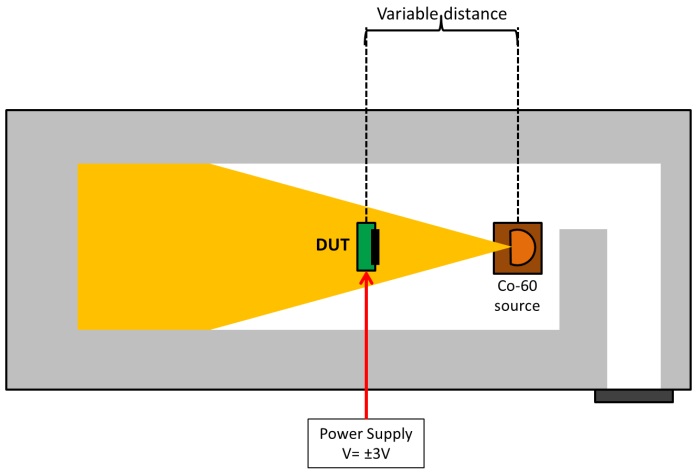
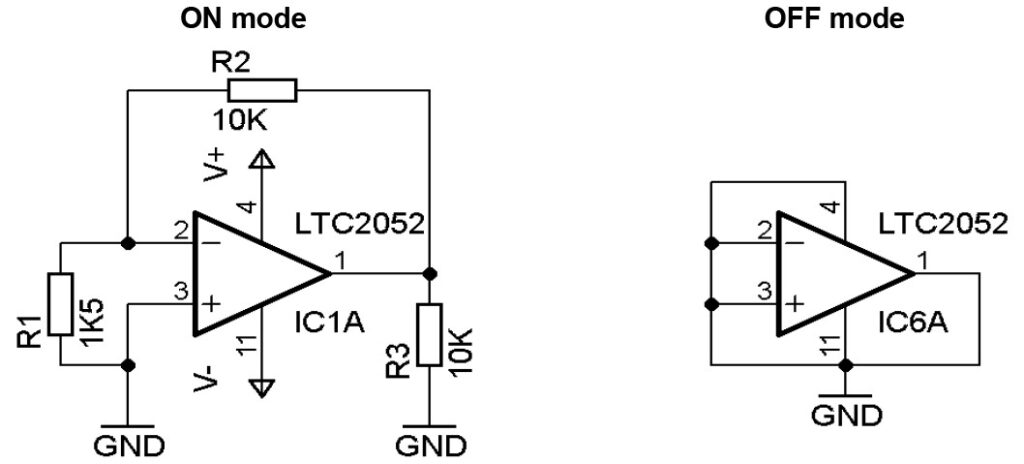
Preparation of the DUT test boards. Here two configurations (Bias Condition) are important. One is the “Off- Mode” where all the pins are connected to ground. The second one is the “On-Mode” where the device is configured in a specific operating state but it will be kept without function, like in “Stand-by” mode. It means no signal will be processed during the test. This two test configurations will be used for the
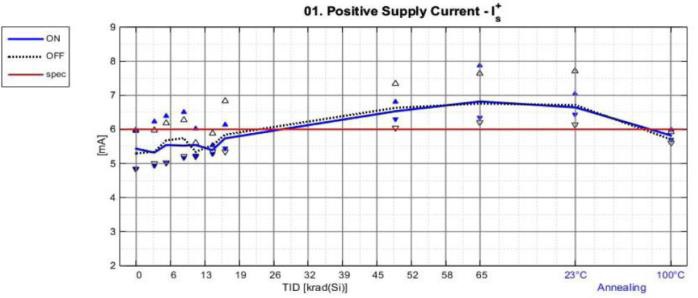
irradiation of the DUTs. A Cobalt-60 will be used as radiation source. During the irradiation, the DUTs will be characterized in time intervals with a tester (Automatic Test Equipment – ATE). The characterization results will show the degradation of the devices during the test. The degradation depends on the accumulated radiation dose. For example, the power consumption will increase the higher the radiation dose.
Upon completion of the test, it is possible to observe the variation of some electrical parameters and in some cases by a specific radiation dose the destruction of the device.
OVERQUALIFICATION? ARE COTS ROBUST ENOUGH?
ITAR components comply with very severe requirementsand offer a high reliability for their usage in extremeenvironments. An ITAR component can have a radiationtolerance of 300 krad. During a LEO mission, a total dose of 1krad will be accumulated in one year [4]. In this case the use ofITAR components does not match the mission requirements. Itis valid to say that the ITAR components are over-qualified forLEO missions.
Furthermore, the ITAR problematic is bound with export restrictions. The export licensing process takes around six months and there is no guarantee to get the permission. This is a major problem for small and medium-sized enterprises (SMEs) also American SMEs and retards their business process. Another disadvantage is that the ITAR EEE parts are based on a robust but also old technology, and do not reach the newest High-Tech electrical and functional levels. Another important point is the price of ITAR components, which is very high and a financial obstacle for SMEs that want to enter in the space field and are not in possession of major capital resources.
The new space era begins with the born of the Picosatellites. In February 2000 the Stanford University launched the microsatellite OPAL. This satellite was the mothership of six Picosatellites, which demonstrated the feasibility of new space platforms for research experiments.
Since the beginning of the century such new space platforms has been used by many universities, research institutes and space companies for research, technology demonstration, technology validation and commercial services. In order to keep costs low, Commercial-Of-The-Shelf (COTS) components have being used. These components support the missions for a limited period, however reborn the usage of COTS components in space. Nowadays many institutions continue developing and launching nanosatellites based on COTS. The installed components will be in very rare mission qualified or even the use of very few ITAR components happened. Most of these missions never qualify the electronic components and trust in the performed simulations and to luck. In the best case the developing teams do test the electronics but in a module level or a board level. During this process, the electronic board will be irradiated with gamma rays and will be tested with a test software until errors appear or in case nothing happen the test will be considered as passed. This solution is often practiced however; it is not the professional way to develop space electronics. The standard procedure from the ESA and NASA testing each component is the recommended way to design electronics for space, especially because is necessary to understand the behaviour of all components under such
conditions. In conclusion, each component of the system should be tested in order to comply with the mission requirements, and the components must be selected before the mission design begins. The uncertainty of not knowing for how long the electronics will properly work in space will never permit the professional development of small satellites, what is a necessity for high quality commercial services and products.
NEWSPACE
NewSpace is a terminology, which represents the philosophy related to the emerging private space industry. This community is built mainly from space companies involved in the development of low-cost space technologies and the definition of low-cost policies. In other words the space technology will be to a mass product and practically accessible for everybody.
It is important to remark that ITAR solutions do not match with the NewSpace philosophy and in consequence, new solutions have to be found.
One of the most interesting parameters for devices in space is the radiation robustness. Such parameter cannot be found in the datasheets of commercial parts. All electronic components could survive in space but the question is for how long!
In the datasheet of a commercial component, the behaviour of the electrical parameters under normal conditions (on the ground) will be assessed. In addition, the limits of these parameters can be found. For instance in the datasheet is
possible to read the Absolute Maximum Ratings like the temperature limits, let say from -10°C to +50°C. It does not mean that under or above these limits, the component will not work anymore. A test in a thermal-chamber will show the real
limits of the component, following the example above i.e. from -15°C to +58°C. It means the same components could be used for a broader temperature range than specified in the datasheet.
In general it is possible to see how robust is an electronic component measuring its behaviour under specific environment conditions.
The NewSpace philosophy and the approach described above are merged in the Space-COTS project.
The most important impact of the Space-COTS is the support of the NewSpace philosophy and the emerging private space industry.
THE SPACE-COTS STORY
After the text edit has been completed, the paper is ready Space-COTS is a pure NewSpace concept and allow the access to commercial components qualified for space. Jaime Estela, from the German/Peruvian Company Spectrum Aerospace, invented the term “Space-COTS” and its concept. The research work started in 2008 by supporting CubeSat projects in Europe and in South America. In this
process, a deep knowledge of the CubeSat technology and its requirements and constraints was gained. Furthermore, the experience in research corroborated the use of commercial electronics in the space business. Working for the German
Aerospace Agency (DLR) in satellite projects and the close contact to ESA standards gave an understanding of the long and expensive way of the traditional qualification of EEE parts.
The DLR’ Standardization and EEE-Parts Division and the ESA Component Space Evaluation and Radiation Effects Section instructed the Spectrum Aerospace team the concept and philosophy of the test procedures for EEE parts.
These experiences together crystallized in the innovative concept of the Space-COTS finding the middle point between not qualified parts at all (i.e. in CubeSats) and full qualified ITAR parts. Looking at the small satellite history many commercial parts can work in space for several years although they were not designed for space applications. However, reliable commercial EEE parts have to be identified. Middle of 2015 due to the participation in the Horizon-2020 program a feasibility study was conducted, where Jaime Estela (author) evaluated the components used in different satellites and identified the most used parts. The result of this study led to edition of the first Space-COTS catalogue, which will be
published in the community portal “space-cots.com” soon. The aim of this catalogue is to list the major quantity of active and passive electronic, electric, and electro-mechanic parts covering almost all the space mission needs. This solution is more efficient and creates at the start phase the same situation like by the traditional satellite developers, where they get a list of ITAR components that they have to take for any design. The idea is to offer later a broader selection of components so that the Space-COTS catalogue will be similar as the component
manufacturers and distributors. The selection of the best commercial parts and its
qualification represents the best Price/Quality Ratio and no other solution can offers so many advantages. Space-COTS will be tested and qualified in different levels, depending of the qualification deepness it looks as follow:
- Class A: Full screening test
- Class B: TID and SEE test
- Class C: TID test
These classes follow the ESA/NASA Standards and new standards coming from the International Organization for Standardization (ISO). The more intensive the test higher the cost of the qualified devices and equipment. Anyway, this solution is much cheaper than the ITAR products. Between the price of commercial parts without qualification and the Space-COTS is well arranged.
The Space-COTS catalogue is classified in component groups. Each group involves the same type of components.
Following groups were defined: diodes, bipolar Transistors, FET, power MOSFETS, OPAMP, comparators, DC/DC converter, voltage regulator, voltage references, ADC/DAC converter, logic devices, drivers, memories, controllers,
FPGAs, sensors, image sensors, optoelectronic-parts among others.
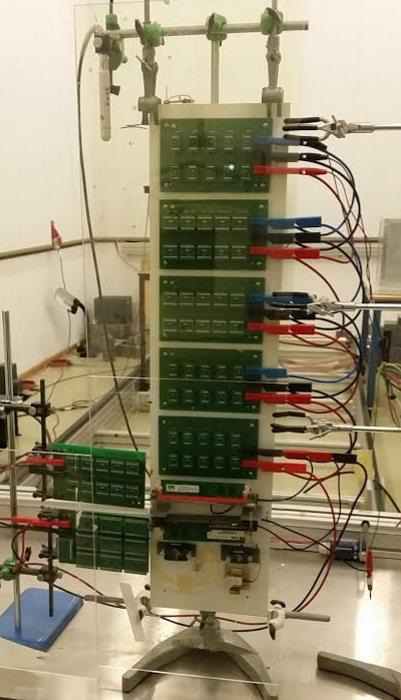
Space-COTS will be used in each space mission but reliable and long life duration devices will be used in the most exigent missions like GEO missions or deep space missions. The qualification of COTS inside one project, where one or few exemplars are needed, does not justify the qualification of each component because the test cost will increase the project budget considerably. Taking account of this Spectrum Aerospace will achieve the qualification of representative amounts of COTS and will bring these into the space market with attractive and competitive prices. Spectrum Aerospace has designed test environments that allow the qualification of a big amount of parts and in a short time.
One important point is to mention that new generation components will be included in a short time in the Space-COTS catalogue and it will be available for the acquisition quickly.
Following formula is valid for the origin of Space-COTS:
COTS + Innovative Qualification Test = Space-COTS
Spectrum Aerospace identifies the best COTS, qualifies it and then offers it to the best price to you!
THE SMALL SATELLITE MARKET
The market of small satellites is growing pretty fast and technical solution and services are necessary to satisfy the real and the dedicated demand of this market. For the manufacture of the small satellite electronics ITAR components are not the right solution thus Space-COTS could represent the best solution. A similar case is with satellite launchers. Small satellites will never fly a space mission so long no dedicated launch services are available and ready to put these small
satellites in the required orbit. The piggyback solution is a case of need or in other words an “emerging solution”.
Forecast studies done by the company Northern Sky Research indicate that more than 3,000 small satellites up to 100 kg will be launched within the next 10 years.
Another forecast by the company Spaceworks predicts that from 2014 until 2025 3.000 small satellites (up to 50 kg) will be launched.
In both forecasts future satellite constellation were considered. The use of constellations promise several benefits like:
- Smaller satellites needed
- Reduction of mission costs
- Reduction in the number of launches and the size ofthe launcher
- Higher performance due to availability of redundant satellites
In such cases the manufacturing of satellites will be analog to a small series production. To cover the needs of such enterprises a higher amount of electronic parts will also be needed and Space-COTS can satisfy this future demand due to
an efficient qualification processes (quality assurance), competitive prices (cost reduction) and a broad portfolio.
FUTURE ACTIVITIES
A. New qualification standards
Space-COTS represent the efficient investment of project funding and provide each project with EEE parts that satisfy the exact mission requirements, with attractive prices, with the corresponding quality level and especially without over-qualification.
In order to support the entrance of new solutions into the space field new standards must be defined. The ISO organization began to treat this situation starting with the edition of new standards. On the ISO website under the term “Design Qualification and Acceptance Tests”, the defined standards related to the space field can be found.
The document related to the components qualification topic is the “Space systems – Design Qualification and Acceptance Tests of Small-scale Satellite and Units Seeking Low-cost and Fast-Delivery”. Topics like qualification test, acceptance test, retest, test plan, test report, test requirements, test levels and duration, Total Ionization Dose test, Single Event Effect test, Electrostatic Discharge test, Electromagnetic Compatibility test and others will be handled there.
B. Enhancement of existing electronics
One problem for the entrance of SMEs to the NewSpace field is that products already exist and the SMEs want to sale these products without modifications for space. Depending on the complexity in many cases is possible to replace the no qualified COTS against Space-COTS but in other cases is not possible.
Spectrum Aerospace considers this as a customer necessity and develops solutions for such cases. In this solution the available design can be kept and in a newly test solution the hardware can be enhanced.
C. New methods for qualification tests
Looking into the future Spectrum Aerospace is planning and coordinating technical solutions to improve the effectiveness of the qualification process with dedicated methods in order to reduce cost and time, but increasing the quality. Some of these selected technologies will be used soon and some others still request research activities to bring the technology to an industrial maturity. Spectrum Aerospace will continue this work and will present in conferences regularly the progress of these activities.
D. Robust by design and future research
Hardware enhancement is a good solution for future satellite design but before a mission design, starts it is recommended to select the components in advance and use robust products like the Space-COTS so that robustness by design is guaranteed and the commercial product obtain automatically a higher quality.
The evolution of the Space-COTS has been initiated and Spectrum Aerospace plans the development and qualification of robust EEE parts including new technologies, materials and protection strategies. These improvements will be presented also regularly in international conferences in the next years.
CONCLUSION
The future of the space industry is in the hand of disruptive technologies, which match the small satellite mission’s requirements. Space-COTS is a disruptive technology of this new space future.