KB-0002 · Radiation Effects · Reference article · Version 1.0
Executive Summary
Single-event effects (SEE) arise when an individual energetic particle causes an electrical disturbance in a device. Effects range from recoverable data corruption to permanent damage. They differ from cumulative-dose mechanisms: an individual event can occur before a device accumulates significant total ionizing dose (TID). SEE analysis must combine particle environment, device susceptibility, operating mode and system-level consequences.
Scope and Applicability
This article introduces SEE terminology and interpretation of test evidence for spacecraft semiconductors. It is not a complete radiation-test procedure or a substitute for a project-specific reliability analysis. Particle species, energy, device architecture and operating conditions determine which tests are relevant.
Main SEE types and their consequences
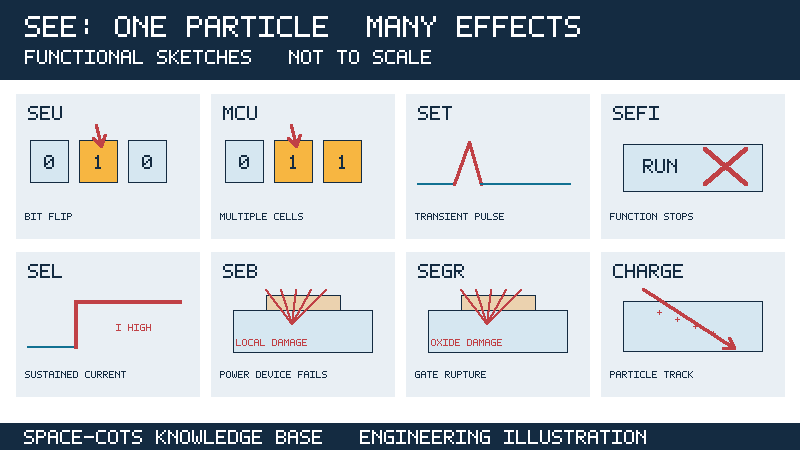
Think of a particle as a brief electrical disturbance at a microscopic location. Whether the device recovers, loses data or is damaged depends on where the particle deposits energy, how much charge is collected and which circuit is affected. A digital memory bit can flip without physical damage; a power device can suffer irreversible damage.
| Abbreviation and meaning | What happens | Possible consequence |
|---|---|---|
| SEU — Single-event upset | Collected charge changes a stored logic state | Wrong data; typically non-destructive |
| MCU — Multiple-cell upset | One particle affects multiple memory cells | Several corrupted bits; may defeat a simple correction code |
| SET — Single-event transient | Temporary voltage or current pulse | Incorrect analogue signal or sampled logic error |
| SEFI — Single-event functional interrupt | Internal control or state machine becomes disrupted | Function unavailable until recovery/reset or power cycle |
| SEL — Single-event latch-up | Parasitic conduction path sustains abnormal current | May be recoverable with prompt protection or permanently damaging |
| SEB — Single-event burnout | Local current and field lead to destructive failure in a susceptible device | Permanent loss of blocking or switching function |
| SEGR — Single-event gate rupture | Gate dielectric suffers local electrical breakdown | Permanent gate damage or leakage |
Other device-specific event classes exist. An MCU is defined at the physical-cell level; a multiple-bit upset in a logical word depends on the memory mapping. Do not assume that every multiple-cell upset corrupts one codeword.
Fundamental Concepts
Energetic particles deposit energy as they travel through matter. Generated charge may be collected by a sensitive semiconductor region and perturb an electrical node. Linear energy transfer (LET) describes energy loss per unit path length; mass-normalized LET is commonly expressed in MeV·cm²/mg. LET is useful in heavy-ion evaluations but is not the sole descriptor of particle-induced response. Track structure, particle energy and range, secondary particles and sensitive-volume geometry can matter. Proton-induced nuclear reactions may generate secondary particles capable of causing SEE; direct ionization can also matter in some technologies.
A single-event upset (SEU) changes stored information. A single-event transient (SET) is a temporary electrical signal disturbance that may propagate and be captured as an error. Single-event functional interrupt (SEFI) describes interruption of device function that may require recovery. Single-event latch-up (SEL) involves an abnormal high-current state; consequences depend on device behaviour and system protection. Single-event burnout (SEB) and single-event gate rupture (SEGR) can be destructive in susceptible power devices. These mechanisms should not be pooled into one undifferentiated event rate.
Mathematical Model and Test Interpretation
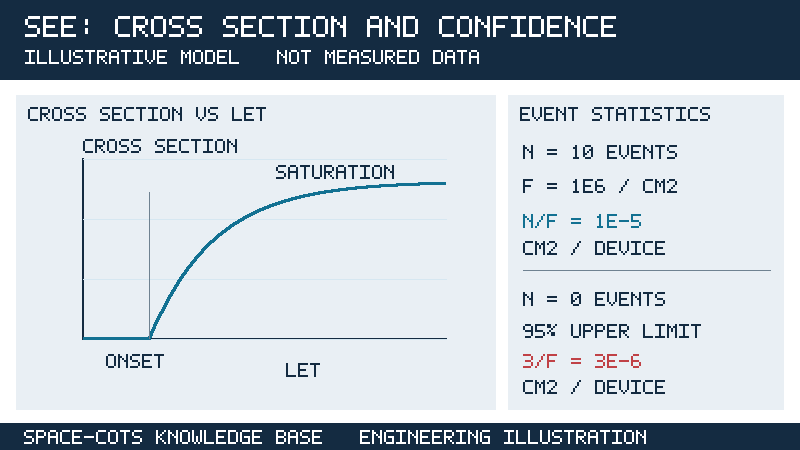
For N observed events during fluence F, an estimated event cross section is σ = N/F, expressed in cm² per device or per bit when normalized explicitly. Ten events during an illustrative fluence of 10⁶ particles/cm² imply 10⁻⁵ cm²/device. This is not a measured Space-COTS result. For zero events, the point estimate is zero but susceptibility is not proven absent. Under a simple Poisson model, the one-sided 95% upper limit is approximately 3/F, assuming an appropriate exposure model and constant rate.
Cross-section curves can be combined with an appropriate differential particle environment to estimate event rate. A simplified expression is λ = ∫ σ(L) φ(L) dL, where L is mass-normalized LET and φ is differential flux in compatible units and geometry. A realistic rate calculation may also need particle species, energy, angular response, shielding and operating-mode dependence. Proton results cannot simply be substituted into a heavy-ion LET curve without a justified model.
Worked example: understanding cross section and confidence
Fluence counts incident particles per unit area; flux measures their arrival rate per unit area and time. If a test exposes a device to 1,000,000 particles per square centimetre and observes ten independent events, the estimated cross section is 0.00001 cm²/device. It is a statistical susceptibility measure, not necessarily a literal geometric area of the chip.
| Fluence (particles/cm²) | Events observed | Cross section (cm²/device) |
|---|---|---|
| 1,000,000 | 10 | 1.0 × 10⁻⁵ |
| 1,000,000 | 0 | Point estimate 0; 95% upper limit ≈ 3.0 × 10⁻⁶ |
| 10,000,000 | 0 | Point estimate 0; 95% upper limit ≈ 3.0 × 10⁻⁷ |
These numbers are illustrative. Under the assumed Poisson model, a longer zero-event exposure places a tighter upper limit on susceptibility. For a population of devices, report how individual exposures were aggregated and what the normalisation means. Cross section is not an event rate until it is combined with the appropriate environment.
Reading a cross-section curve
A typical illustrative heavy-ion curve can show an onset region followed by a rise and eventual saturation. An apparent threshold depends on the tested fluence, sensitivity and detection limit; it is not necessarily a sharp physical boundary. A Weibull function is often used to fit observed cross sections, but its parameters must come from measured data. A fit must not be reported as a measurement or extrapolated beyond its validity.
Practical Engineering Considerations
Select event mechanisms and operating states from the mission-critical functions. Define particle type and energy, LET where applicable, fluence, flux, beam uniformity, range in the sensitive region, bias and temperature. Monitor power rails and outputs continuously where needed; define event classification, detection efficiency, dead time, recovery criteria and test stop conditions. An adequate report identifies devices and samples, test conditions, observed events and statistical basis of upper limits. Destructive and recoverable effects require different system treatment.
Mitigation may include error-detecting or correcting codes, memory scrubbing, watchdogs, redundancy, current limiting and controlled reset or power cycling. Each addresses particular mechanisms and has constraints. Error correction cannot prevent physical destruction, and a watchdog does not restore corrupted persistent state unless a suitable recovery architecture exists. Verify mitigation with fault injection or applicable radiation testing rather than assuming effectiveness.
Space-COTS Engineering Assessment
Use the Space-COTS Characterization Parameter Matrix (SCCPM) to capture evidence of critical functions and destructive effects, diagnostic information such as rail-current response, recovery latency and event class, and complementary information such as operating-mode details. Preserve actual cross-section normalization, counts, fluences and conditions. Plot cross section versus LET or energy only where appropriate; include zero-event upper limits and uncertainties. Compare samples or lots only when conditions and event definitions are sufficiently comparable. Use evidence states independently of the pass/fail decision.
SCCPM example for memory and power devices
| Parameter | Example classification | Evidence needed |
|---|---|---|
| Memory upset cross section | Mission-critical where data integrity is required | Event counts, fluence, bit/device normalisation, operating mode |
| Multiple-cell event topology | Key diagnostic; may be mission-critical for error correction | Physical/logical mapping and event multiplicity |
| Latch-up current and recovery time | Mission-critical for an unprotected supply rail | Current traces, recovery outcome, temperature |
| Burnout or gate rupture | Mission-critical for power switching | Bias, particle conditions, destructive result |
| Test fixture or secondary diagnostics | Complementary unless needed to assess validity | Setup, observation conditions, source |
Use Measured, Not measured, Not reported, Not applicable and Not determined as independent evidence states. For a zero-event test, record the exposure and detection capability; zero observed events is not immunity.
Limitations and Common Misconceptions
No observed upsets in limited exposure does not prove immunity. A total ionizing dose (TID) rating does not establish SEE response. LET threshold and saturation cross section alone do not guarantee mission reliability. A recoverable upset does not necessarily mean mission failure: the consequence depends on criticality, data integrity and recovery time.
Conclusions
SEE assessment translates particle-induced device responses into operational risk. Distinguish event mechanisms, quantify susceptibility under specified conditions and verify system-level mitigation.
Related content
Planned: KB-0001 (TID); KB-0003 (COTS Component Assessment). Link only to validated relevant SEE component records when available.
Visual summary: one particle, different effects
| Signal or state | Recovery | Permanent damage |
|---|---|---|
| SET: short pulse; SEU: stored state changes; MCU: several cells change | Rewrite, error correction or transient filtering may help | Usually no physical damage |
| SEFI: functional interruption; SEL: sustained abnormal current | Reset, power cycling or current protection may help if validated | SEL can become destructive |
| SEB and SEGR: physical damage | Normal reset does not repair damaged material | Potentially irreversible |
The design decision is based on observed event susceptibility, mission environment, criticality and verified mitigation.
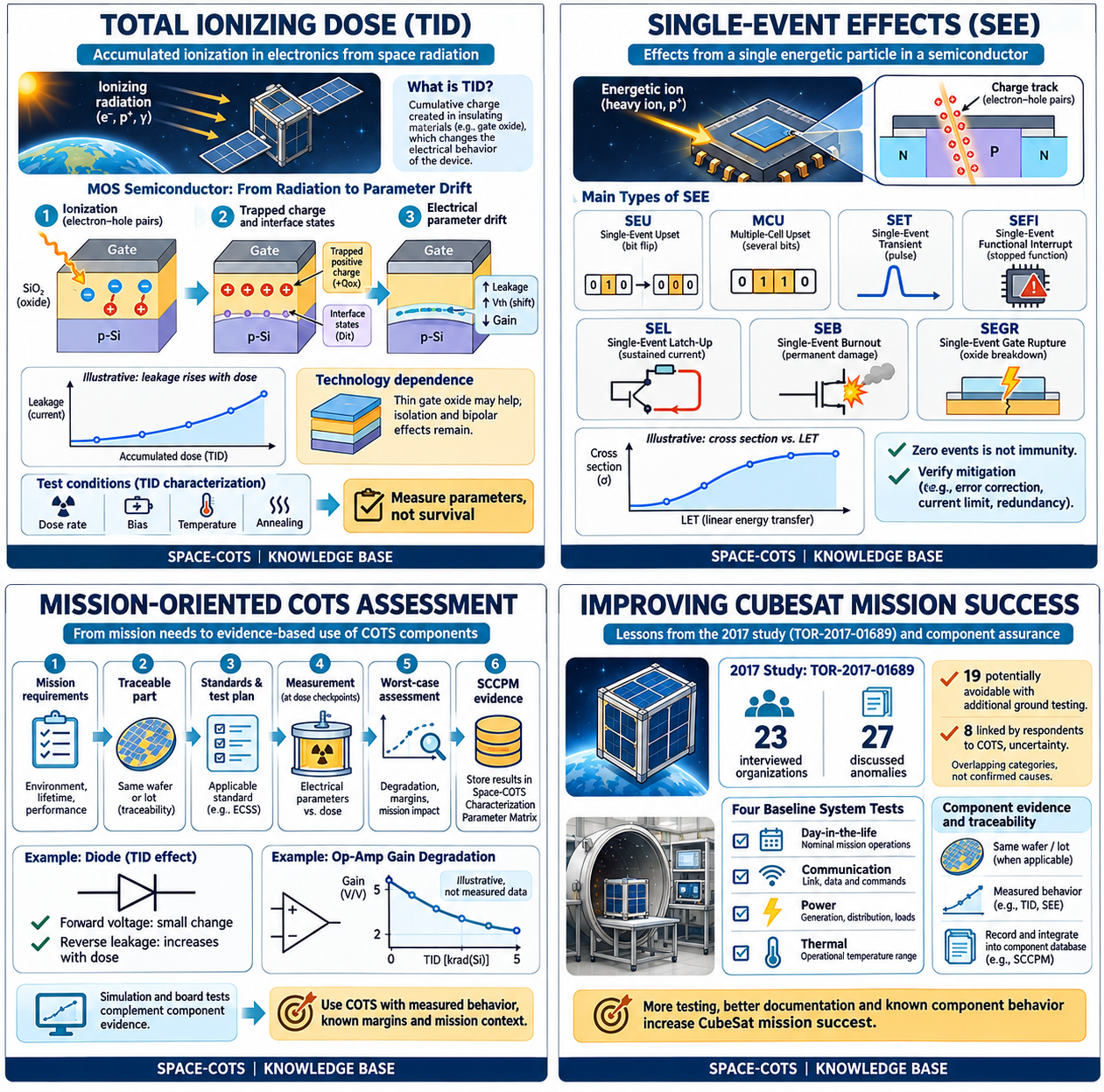
Summary infographic
References and Standards
ECSS-Q-ST-60-15C Rev.1, Radiation hardness assurance, 20 March 2025.
ESCC 25100, Issue 2, Single Event Effects Test Method and Guidelines.
NASA Jet Propulsion Laboratory: Radiation effects in semiconductor devices.
Total Dose Effects on Single Event Transients in Digital CMOS and Linear Bipolar Circuits, NASA Technical Reports Server.
Revision and Verification Information
Version 1.0. Published after editorial approval. Consult the applicable official standards and approved mission requirements.