KB-0004 · Reliability and Failure Analysis · Reference article · Version 1.0
Executive Summary
A CubeSat can be inexpensive without being unreliable by design. In 2017, the U.S. Space Programs Mission Assurance Improvement Workshop (MAIW) investigated lessons learned from CubeSat developers in academia, industry and government-related organisations. Its report, Improving Mission Success of CubeSats (TOR-2017-01689), identifies practical ways to improve mission outcomes despite limited budgets and demanding schedules. For electronic engineers, an especially relevant finding is that uncertainty about commercial off-the-shelf (COTS) parts and assemblies deserves greater attention, including physical testing and better documentation. This article explains the historical study and translates its lessons into a component-assurance workflow for student and professional teams.
Source and scope
The primary source is The Aerospace Corporation report dated 12 June 2017, authored by Catherine C. Venturini and developed with government and industry contributors. The presentation credits Mike Tolmasoff, Renelito Delos Santos and Catherine Venturini. National Aeronautics and Space Administration (NASA) centres participated in the interviews and NASA experts contributed to peer review. NASA hosts a copy; this is a collaborative aerospace report rather than a NASA-issued standard. All statistics below refer to the historical study, not current CubeSat performance.
How the study was conducted
The team used open-ended interviews rather than a controlled reliability experiment. Twenty-three organisations participated: ten academic, five industry and eight government or affiliated research organisations. The team examined 415 pages of interview material, identified 40 recurring themes in eight categories and formulated eight recommendations. Seventeen subject-matter experts reviewed the draft. The methodology is described on printed slides 15–25 (PDF pages 19–29). The study is particularly valuable because the observations came from teams with actual satellite development experience, but the sample is not random and root causes were often uncertain.
What the historical mission outcomes show
| Outcome for satellites that reached orbit | 1U–27U group | Larger than 27U |
|---|---|---|
| Full mission | 65% | 87% |
| Partial mission | 20% | 8% |
| Early loss | 10% | 5% |
| No contact / dead on arrival (DOA) | 5% | 0% shown |
Source: printed slide 29 (PDF page 33). The unit U refers to the CubeSat size unit. These respondent-reported percentages are rounded. They exclude launch losses and cannot be compared directly with statistics using all launches as their denominator. A comparison on slide 30 uses different denominators and populations; the report cautions that the interviewed teams may have more prior experience.
Twenty-seven anomalies: what went wrong?
| Interviewee-reported contributor or opportunity | Number among 27 anomalies |
|---|---|
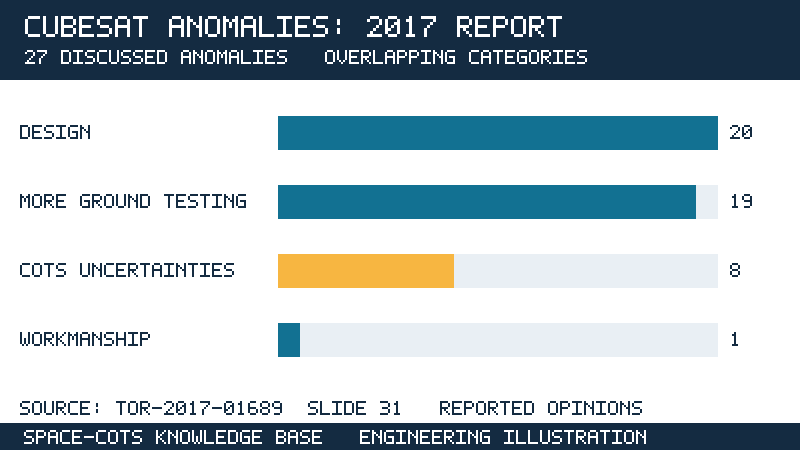
| Design issues | 20 |
| Potentially avoidable through additional ground testing | 19 |
| Uncertainties associated with COTS parts | 8 |
| Workmanship | 1 |
Source: printed slide 31 (PDF page 35). Categories overlap: one anomaly may have multiple contributors. These are reported opinions about possible causes, not verified root-cause assignments. In particular, the eight COTS-related cases must not be described as eight confirmed radiation failures or as a population-wide failure rate. The important engineering lesson is that better evidence about components and more targeted ground verification could reduce avoidable uncertainty.
The eight recurring themes
| Theme | Implication for a CubeSat team |
|---|---|
| 1 — Mission purpose and vision | Define realistic objectives and a minimum viable mission before hardware selection. |
| 2 — Programme structure | Retain documentation, experienced mentors and peer reviews; protect test time. |
| 3 — Risk process | Identify critical functions and allocate limited resources to the most consequential unknowns. |
| 4 — Design and analysis | Prefer simple robust architectures, margin, recovery paths and testable subsystems. |
| 5 — Integration and test | Verify hardware and software together and at appropriate subsystem stages; preserve evidence. |
| 6 — Software | Test actual operating scenarios and changes, including failure and recovery behaviour. |
| 7 — Parts quality, availability and documentation | Do not assume commercial parts meet space conditions. Verify data and procure traceable samples. |
| 8 — Launch constraints | Avoid compressing essential testing into the last days before delivery. |
Why COTS assurance matters: Theme 7
Printed slides 60–62 (PDF pages 64–66) discuss commercial hardware selected for its cost and short lead time. Respondents identified cases where published descriptions did not match the hardware or intended environment. The report argues for a greater emphasis on testing alongside analysis, stronger documentation, derating and a database of commercial assemblies and components with known performance. This is directly relevant to the Space-COTS Component Database concept: searchable and traceable evidence can reduce duplicated work and help inexperienced teams make informed decisions.
The report does not specify a universal radiation test procedure, nor does it demonstrate that every CubeSat failure results from COTS parts. Radiation assurance, sample traceability and component characterization are additional engineering measures to apply according to the mission’s risk and governing requirements.
Eight actionable recommendations from the report
| Recommendation | Practical implementation |
|---|---|
| 1 — Define scope and success criteria | Document minimum mission performance, lifetime, available resources and a controlled scope-reduction plan. |
| 2 — Protect integration, verification and test (IV&T) time | The report recommends reserving roughly one-third to one-half of the overall programme schedule for IV&T. Start testing early. |
| 3 — Risk-based assurance | Maintain a risk register, rank critical uncertainties and connect them to analyses and tests. |
| 4 — Simplicity and robustness | Use suitable margins, validated recovery mechanisms and graceful degradation; reduce unnecessary complexity. |
| 5 — Experienced team | Engage mentors and independent technical reviewers; preserve knowledge as students graduate. |
| 6 — Spare components | Procure extra traceable parts and boards to enable meaningful tests, repairs and parallel development. |
| 7 — Four essential system tests | Perform operational scenario, communication, battery/power and thermal tests; supplement according to mission risk. |
| 8 — Validate supplier information | Verify received hardware against expected performance rather than assuming that its data sheet is complete. |
Source: printed slides 69–84 (PDF pages 73–88). These are scalable recommendations, not universal contractual qualification requirements.
Four essential system-level tests
| Test | What the test establishes |
|---|---|
| Day-in-the-life or longer | End-to-end nominal hardware and software operation, representative commands, data and energy cycles. |
| Communication link | Actual ground-to-spacecraft communication capability and link performance under representative conditions. |
| Power charge/discharge | Whether the as-built power system produces, stores and delivers required energy. |
| Thermal testing, preferably in vacuum | Operation at temperature extremes and correlation of the thermal model with measured hardware. |
The original report then recommends additional tests based on risk. Radiation testing is not among its four baseline system tests, and this list must not be treated as a complete radiation-hardness-assurance plan. Component-level radiation characterization answers different questions: whether a particular device population has acceptable electrical behaviour under relevant radiation conditions. Both levels are valuable.
Space-COTS engineering interpretation: from system risk to component evidence
Start with a bill of materials (BOM) for every essential electrical function. For each electronic component, identify manufacturer, exact ordering code and available lot or process traceability. Establish its application conditions, expected environment, design margins and consequence of failure. Review applicable standards and existing reports. A simulation can estimate orbital exposure, shielding or circuit response if the model is appropriate; it cannot reliably establish an unknown chip’s radiation behaviour without supporting data. Commercial component internal structures and process information are often proprietary, and ordinary circuit models usually do not include calibrated radiation degradation.
For gaps in radiation evidence, define and carry out appropriate measurements under approved conditions. Separate total ionizing dose (TID), displacement damage and single-event effects (SEE). Characterize parameters at suitable test checkpoints and document changes, including loss of performance before complete failure. Apply the European Cooperation for Space Standardization (ECSS) commercial EEE-component and radiation-hardness-assurance standards when applicable. EEE means electrical, electronic and electromechanical. Test methods, dose rates, sample populations and acceptance criteria must be justified, not chosen merely to reduce facility cost.
Board-level irradiation and system demonstrations are useful complementary evidence, but a board that still functions has not demonstrated that every individual component is qualified. Conversely, a device with a measured parameter shift may remain suitable in a design that meets its mission limits over the validated range. The decision is based on known behaviour and documented risk acceptance, not marketing terminology.
Worked example for a university mission
Suppose a student CubeSat uses a commercial voltage regulator to power its main processor. The regulator has a commercial data sheet but no traceable radiation results for the intended device population. A power-system simulation indicates sufficient energy in nominal conditions. The team must still consider radiation-induced standby-current drift, output accuracy, dropout, thermal behaviour, recovery and any applicable destructive-event mechanisms. Select an appropriate sample population and test programme with experienced guidance; compare measured worst-case values against the approved design margins. If the regulator fails those limits, change the design or select another device. If evidence is missing, document the gap and obtain the required disposition rather than relabelling the component as qualified.
Connecting the report to SCCPM and the component database
The Space-COTS Characterization Parameter Matrix (SCCPM) is a Space-COTS framework for preserving parameter-level evidence. A regulator record should include mission-critical output voltage and current budget, diagnostic dropout and transient response, and other complementary measurements as appropriate. Every parameter has an evidence status: Measured, Not measured, Not reported, Not applicable or Not determined. Store the conditions and source document separately from the engineering judgement. A report with missing data may remain useful but must not be represented as a complete qualification certificate.
Practical checklist for student teams
| Checkpoint | Evidence to retain |
|---|---|
| ☐ Mission performance and intended life | Requirements and environment assumptions |
| ☐ Critical component functions | BOM, criticality and risk register |
| ☐ Reliable procurement and spares | Part and lot records |
| ☐ Standards and test strategy | Approved methods, samples and limits |
| ☐ Characterize hardware early | Individual measurement results and test reports |
| ☐ Integrate and verify | System-level operational, communications, power and thermal test evidence |
| ☐ Review remaining risks | Independent review and approved disposition |
| ☐ Preserve knowledge | Traceable records in the database and lessons learned |
Limitations and common misconceptions
The 2017 study provides historically important qualitative evidence and practical guidance. Its interview statistics cannot establish causation or current failure rates, and some failures involved several simultaneous contributors. Do not use its recommendations as a substitute for applicable mission requirements or cite its findings as proof of any individual commercial supplier’s performance. Qualification claims must identify the scope of the evidence and the approving authority.
Conclusions and visual summary
| Mission objective | Engineering action | Outcome sought |
|---|---|---|
| Know what success means | Define requirements and risks | Realistic mission |
| Know the electronics | Measure and characterize critical COTS | Evidence-based selection |
| Know the system | Verify integrated hardware and software | Verified operation |
| Know what remains uncertain | Document limitations and share test evidence | Reduced avoidable uncertainty |
The report’s enduring lesson is that a limited budget is a reason to prioritize meaningful verification, not to replace it with unsupported assumptions. Space-COTS extends this principle by preserving component-level measurement and traceability so future developers can reuse knowledge responsibly.
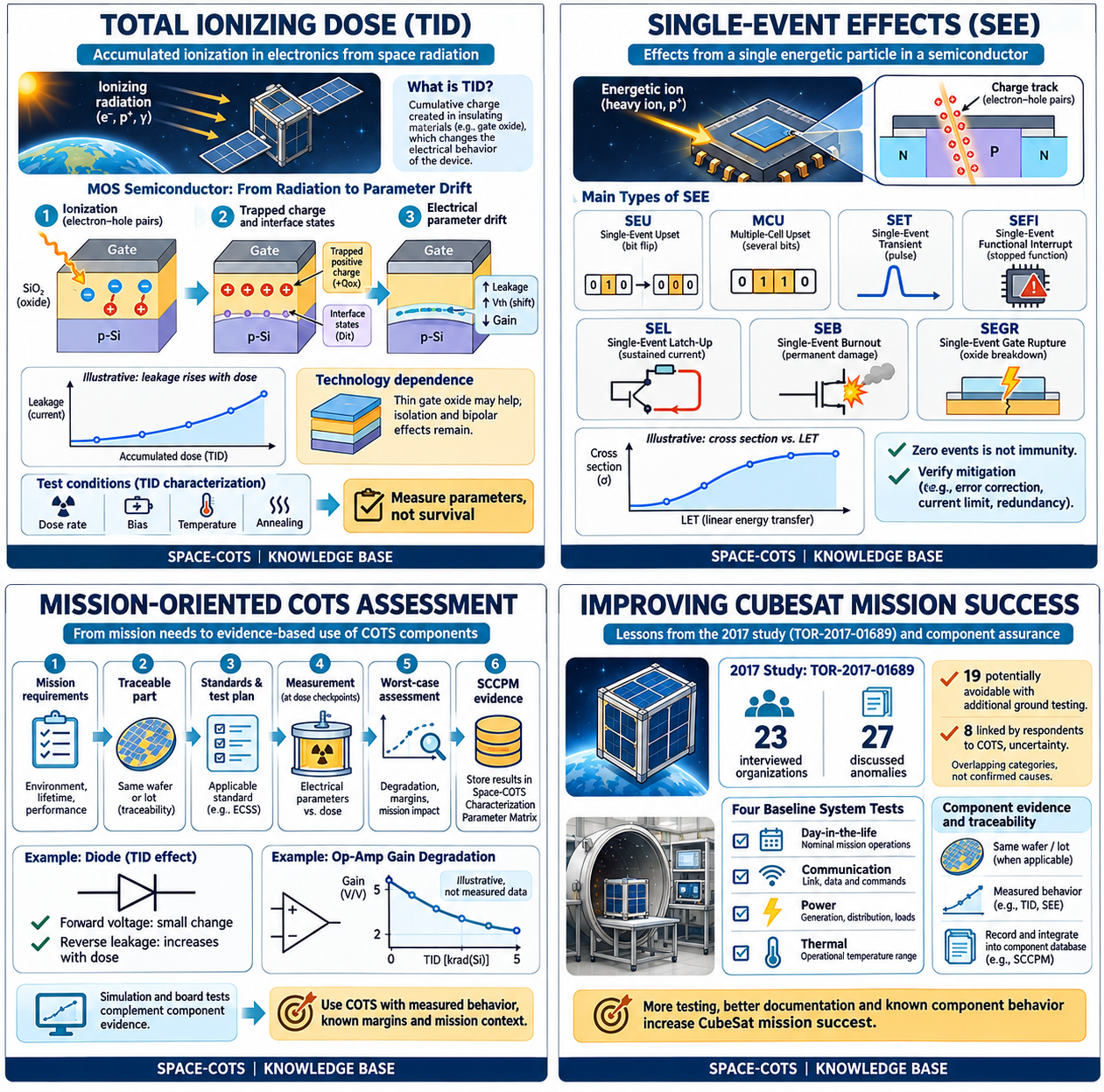
Summary infographic
References and revision information
Catherine C. Venturini, The Aerospace Corporation, Improving Mission Success of CubeSats, TOR-2017-01689, 12 June 2017. Full original report (NASA-hosted PDF). Publisher’s report page.
ECSS-Q-ST-60-13C Rev.2 (30 April 2025); ECSS-Q-ST-60-15C Rev.1 (20 March 2025). These later standards are supporting engineering context, not sources used by the 2017 report.
Related reading: KB-0001 TID; KB-0002 SEE; KB-0003 COTS assessment. COTS Component Database. Version 1.0. Published after editorial approval.